
Call us now :07313727211
 Send Inquiry
 Send Inquiry
Dorry Abrasion Testing Machine
Price 65000.0 INR/ 1
MOQ : 1 Number
Dorry Abrasion Testing Machine Specification
- Hardness
- Hardened steel disc
- Temperature
- Ambient
- Test Range
- Suitable for stone and aggregate abrasion test
- Resolution
- 0.01 mm loss
- Operating Voltage
- 230V AC
- Number of Specimens
- 1 per test cycle
- Mounting Type
- Free-standing
- Response Time
- Immediate
- Application
- Determination of resistance to abrasion for aggregates
- Equipment Type
- Abrasion Testing Machine
- Specimen Size
- Standard 50mm x 50mm x 25mm (approx.)
- Max Height
- Approx. 1 meter
- Humidity
- Ambient
- Display Type
- Analog (manual measurements)
- Measuring Range
- Up to 3 kg abrasive load
- Frequency
- 50 Hz
- Accuracy
- 1% of reading
- Features
- Heavy-duty construction, replaceable wearing disc
- Power Supply
- 230V AC, 50 Hz
- Automation Grade
- Manual
- Usage
- Laboratory testing
- Capacity
- Up to 3 kg of abrasive charge
- Machine Weight
- Approx. 50 kg
- Test Speed
- 28-30 rpm
- Test Width
- Standard 25 mm
- Test Stroke
- 360 revolution
- Control Mode
- Manual
- Finish
- Powder coated
- Noise Level
- <70 dB
- Construction Material
- Mild steel with anti-rust coating
- Abrasive Type
- Standard abrasive powder
- Abrasive Disc Diameter
- 200 mm
- Compliance Standards
- IS 2386 (Part IV)
- Sample Loading Mechanism
- Counter-weighted arm system
- Calibration
- Manual, provided with reference blocks
- Protective Shield
- Enclosed with sheet metal guard
Dorry Abrasion Testing Machine Trade Information
- Minimum Order Quantity
- 1 Number
- Delivery Time
- 1 Week
Dorry Abrasion Testing Machine About
Product Details:
| Minimum Order Quantity | 1 Piece |
| Load | 13.6 kg |
| Disc Speed | 30 rpm |
| Material | Mild Steel |
| Usage/Application | Aggregate Test |
| Weight | 100kg |
| Power | Electric |
| Phase | Three Phase |
| Voltage | 230 |
AS PER BS: 812 The machine is used to determine the resistance of aggregate to wear by abrasion. Inadequate abrasion resistance of road-surfacing aggregates means an early loss of the texture depth required to maintain high-speed skidding resistance.
Salient Features
- Specification :It consists of a disc rotating about a shaft connected to a reduction gear box coupled to a motor. The disc rotates at 28-30 r.p.m. Under the rotating disc is a tray with an outlet to facilitate the removal of sand. Two conical hoppers are mounted on a bracket fixed to the circular tray. An arrangement is made for start and stop the flow of sand. Two holes are provided for mounting two specimens simultaneously. Two containers with weights are supplied to keep the specimens pressed against the rotating disc. Suitable for operation on 220 volts, 50 cycles, A.C. supply.
Dorry Abrasion Testing Machine Manufacturer in Coimbatore, Dorry Abrasion Testing Machine Dealer in Coimbatoer, Dorry Abrasion Testing Machine in Coimbatore,
Purpose-Built for Aggregate Durability Testing
Developed with laboratory precision, the Dorry Abrasion Testing Machine facilitates reliable measurement of aggregate and stone resistance to surface wear. Its compliance with IS 2386 (Part IV) ensures results meet industry benchmarks, supporting material selection and quality control in construction and research applications.
Engineered For Accuracy and Safety
Equipped with a manual calibration system-using reference blocks-and an analog reading display, this machine ensures precise abrasion measurements, with 1% reading accuracy and immediate response. The enclosed metal guard enhances operation safety, safeguarding users during each complete 360 revolution test stroke.
Robust Construction for Extended Service Life
Crafted from powder-coated, anti-rust mild steel, the machine stands up to rigorous laboratory use. Features like replaceable hardened steel discs and a counter-weighted arm system help minimize wear and streamline specimen changes, while its free-standing, space-efficient design suits most laboratory environments.
FAQ's of Dorry Abrasion Testing Machine:
Q: How does the Dorry Abrasion Testing Machine measure aggregate abrasion resistance?
A: The machine uses a rotating 200 mm abrasive disc and standard abrasive powder to abrade a specimen mounted on a counter-weighted arm. After a set number of revolutions (360), the loss in specimen material is measured manually, providing a quantitative assessment of abrasion resistance as per IS 2386 (Part IV) standards.Q: What is the process for calibrating the machine before testing?
A: Calibration is performed manually using the provided reference blocks to ensure accuracy. Users should follow the included guidelines to adjust the mechanism and confirm the analog display is correctly set before beginning a test cycle.Q: When should the wearing disc be replaced?
A: It is advisable to inspect the hardened steel disc regularly for significant wear or scoring. Replace the disc whenever you notice loss of surface integrity to maintain measurement accuracy and prolong the machine's service life.Q: Where can the Dorry Abrasion Testing Machine be used?
A: This machine is optimized for laboratory environments in research, quality control, construction material analysis, and educational institutes. Its free-standing, compact design makes it suitable for bench-top or floor use wherever aggregate abrasion testing is required.Q: What are the benefits of using the enclosed sheet metal guard during testing?
A: The protective enclosure ensures safety by containing debris and reducing operator exposure to moving parts and abrasive powder. It also helps in maintaining a cleaner testing area and mitigates noise, keeping operational sound below 70 dB.Q: How many specimens can be tested per cycle, and what is the standard size?
A: The machine accommodates one specimen per test cycle, with the standard recommended size being approximately 50mm x 50mm x 25mm. This ensures compliance with IS 2386 (Part IV) and repeatability across testing sessions.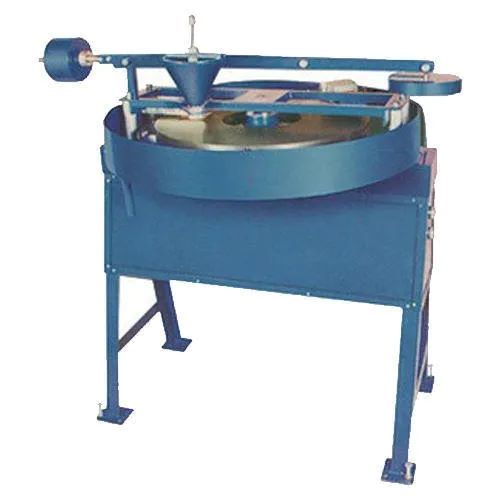
Tell us about your requirement

Price:
Quantity
Select Unit
- 50
- 100
- 200
- 250
- 500
- 1000+
Additional detail
Mobile number
Email

More Products in Concrete Testing Machine Category
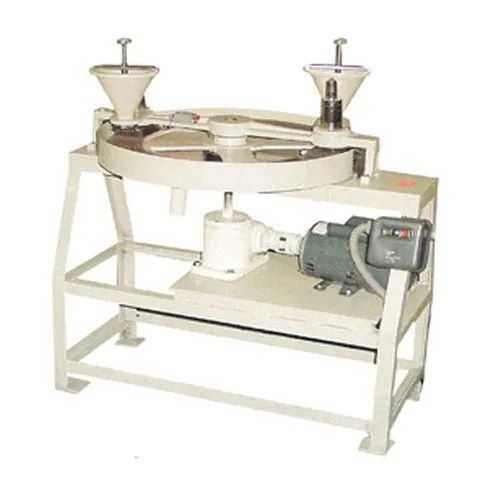
Dorry Abrasion Testing Machine
Price 55000.0 INR / Unit
Minimum Order Quantity : 1 Unit
Power Supply : 220240V AC, 50Hz
Mounting Type : Floor mounted
Usage : Lab testing for aggregate abrasion
Application : Determination of resistance to abrasion of aggregates
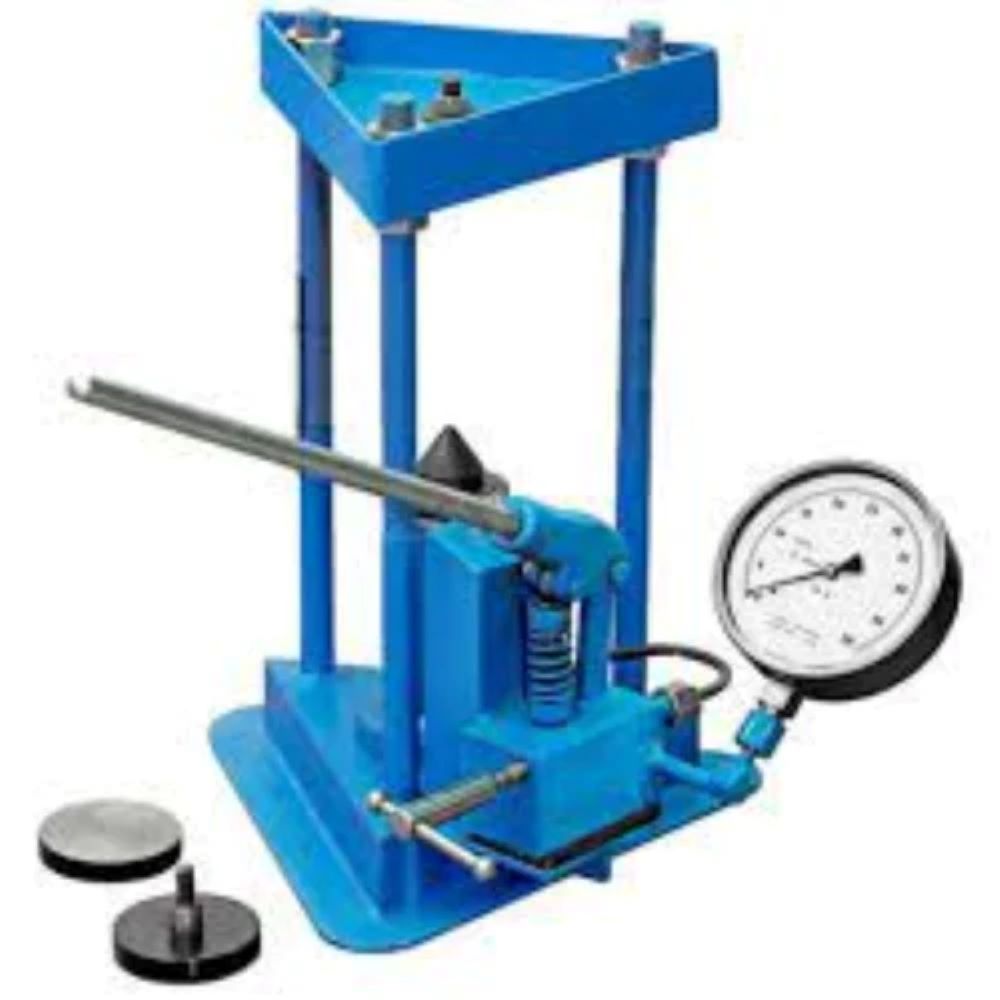
Point Load Intex Tester
Price 55000.0 INR / Number
Minimum Order Quantity : 1 Number
Power Supply : Not Required (Manual Operation)
Mounting Type : Bench/Table Mount
Usage : Measurement of Rock Point Load Strength Index
Application : Rock Strength Testing, Geotechnical Investigation, Laboratory and Field Testing
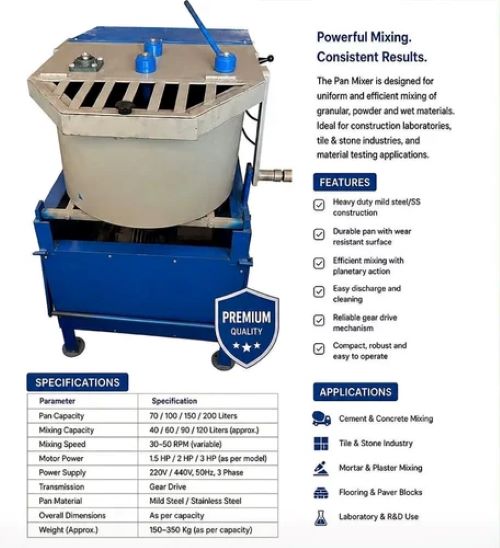
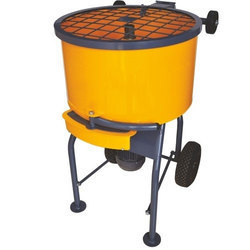
Pan Concrete Mixer
Price 85000.0 INR / Piece
Minimum Order Quantity : 1 Piece
Power Supply : 440V, 50Hz, 3 Phase
Mounting Type : Floormounted
Usage : Uniform and efficient mixing of granular, powder and wet materials
Application : Cement & Concrete Mixing, Tile & Stone Industry, Mortar & Plaster Mixing, Flooring & Paver Blocks, Laboratory & R&D Use
Labomix Concrete Pan Mixer
Price 140000.00 INR / Piece
Minimum Order Quantity : 1 Piece
Power Supply : Electric
Mounting Type : Floor Mounting
Usage : laboratory

We are dealing in Coimbatore, Chennai and Tamilnadu.
 Send Inquiry
Our Products
- Concrete Testing Equipment
- Survey Lab Equipment
- Construction Equipment
- Concrete Testing Machine
- Auto Level
- Soil Test Machine
- Survey Instrument
- Cement Testing Machine
- Soil Testing Equipments
- Soil Testing Equipment
- Civil Engineering Lab Equipment
- Total Station
- Soil Test equipments
- Concrete Highway Engineering lab
- Mechanical Engineering Lab Equipment
- Weighing Scale
- Laboratory Testing Equipment
- Workshop Trolleys
- Compression Testing Machine
- Water Testing Equipment
- Cube Mould
- Non Destructive Testing Equipment
- Core Cutting Machine
- Digital Measuring Machine
- Oil & Petroleum Testing Equipment
- Drawing Instruments
- Fuel Testing Equipment
- Dynamics Lab Equipment
- Hydraulics and Fluid Mechanics Lab Equipment
- Heat Transfer Lab Equipment
- Scientific Equipment
- Standard Sand
- Hot Air Oven
- Tamping Rammer
- Structural Engineering Lab Equipment
- Pharmaceutical And Microbiology Testing Laboratory
- Thermal Engineering Laboratory Equipment
- Liquid Mercury
- Vibrating Table
- Material Testing Equipment
- Waste Water Analysis
- Precision Measuring Instruments
- Walk Behind Double Drum Roller
- Vernier Theodolite
- Bitumen Testing Equipment
- Agriculture Equipment
- Bosch Measuring Tools
- Concrete Mixer Machine
- Concrete Power Trowel
- Bar Cutting Machine
- Concrete Vibrator
- Construction Mini Lift
- Bar Bending Machine
- Construction Power Tools
- DGPS Survey Equipment
- Double Wheel Barrow
- Automobile Tools
- Aggregate Testing Equipment
- Alcohol Breath Analyser
- Construction and Building Equipments
- Earth Rammer
- GARMIN Handheld GPS
- General Laboratory Equipment

SF No. 189/1B1A, 191/3A1A1E, Sidco Private Industrial Estate, LIC Colony, Kurichi Pudhu Nagar, Kuruchi Housing,Coimbatore - 641021, Tamil Nadu, India

Mr Balamurugan C
(Manager)
Mobile :07313727211
 Send Inquiry
 Send SMS
Developed and Managed by Infocom Network Private Limited.
